Brief Overview
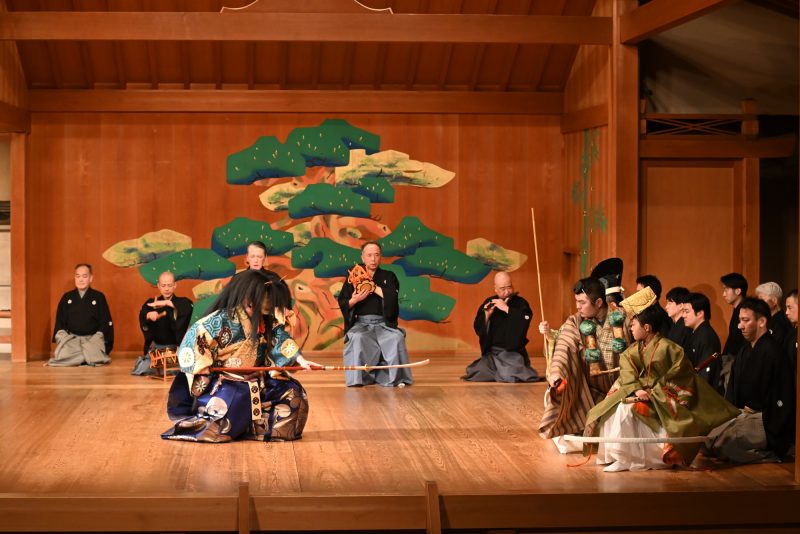
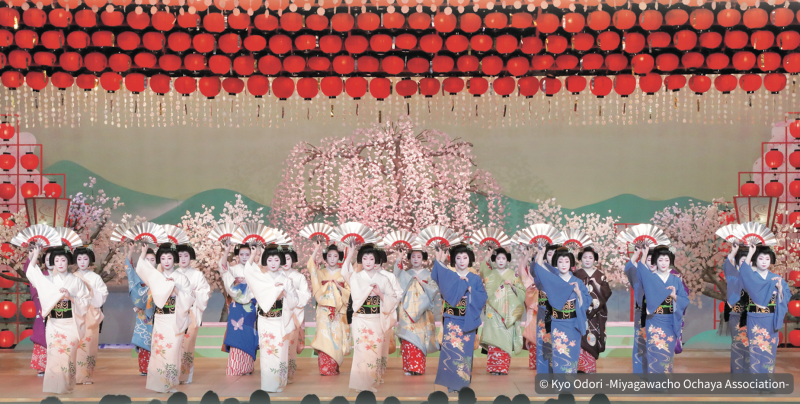
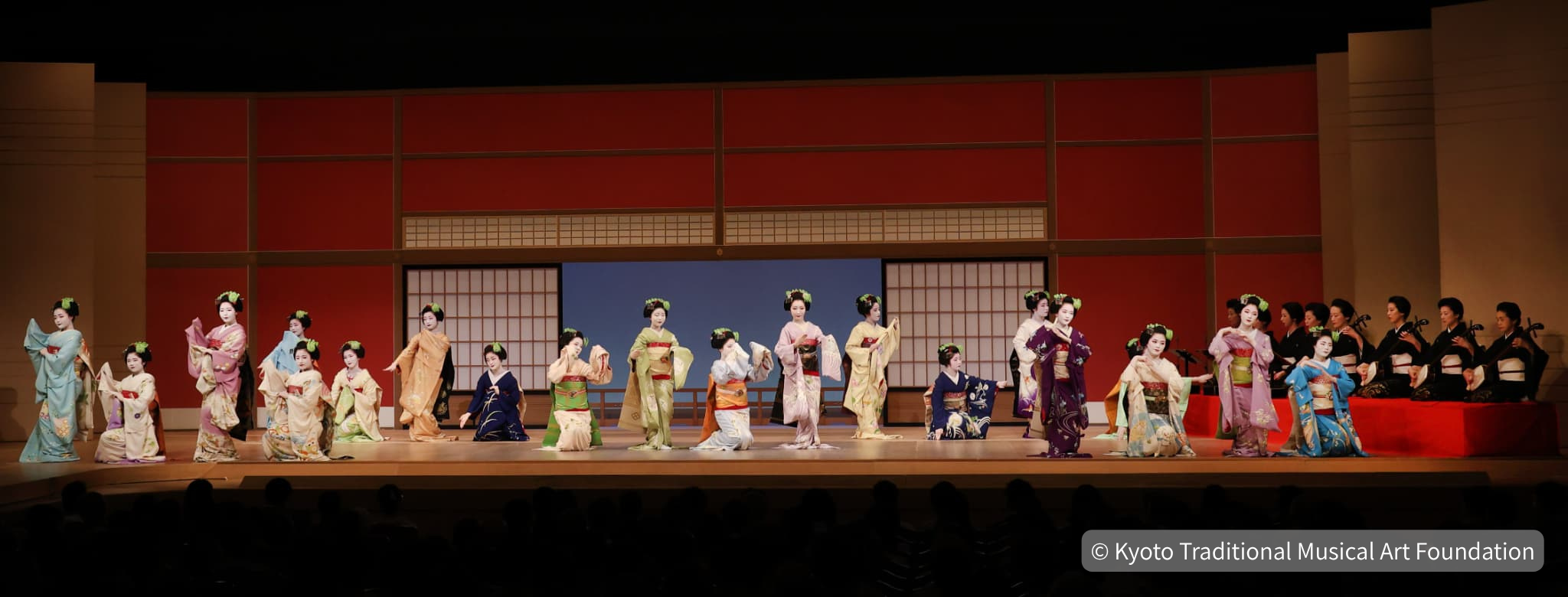
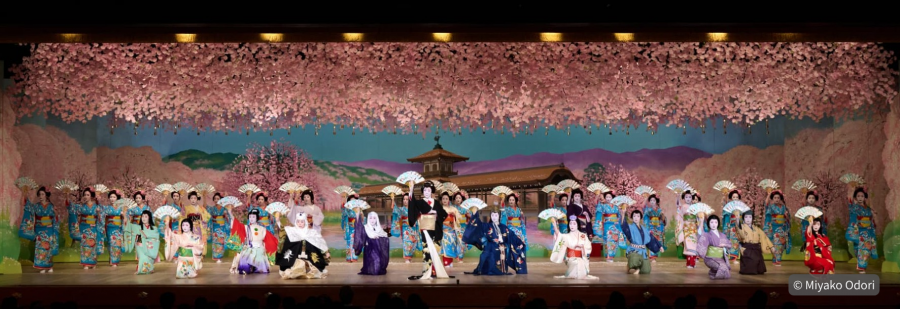
Nihon Buyo is a collective term for traditional Japanese dance performance. A dancer performs with choreography (“furi”) along with singing and the music of the shamisen (three-stringed instrument) and other traditional instruments. It was originally developed by absorbing dance elements of Nohgaku and other local folkdance forms. The fundamental elements of Nihon Buyo were established during the Edo period (1603-1868), when it extracted the lively dance portions of Kabuki that were already popular among the urban populace, from commoners to the samurai class. This contributed to the main aspects of the present form of Nihon Buyo. Another style of Nihon Buyo derived from the Noh dance, “mai,” or circular dances, flourished in the Kamigata (areas in and around the Kansai region) and is still alive today.
What is Nihon Buyo?
Buyo speaks for itself
Buyo does not incorporate theatrical elements such as monologues or dialogue by the performers. The dance itself is everything, as the performers express all their feelings and intentions using only a fan (or other small props) and their body movements. There are a variety of Buyo pieces featuring romance and regret, the changing of the seasons, historic Chinese and Japanese legends and more.
Buyo was an essential cultural accomplishment for individuals
Kabuki reached its height of popularity in the mid-Edo period. Many commoners, inspired by Kabuki, wanted to learn Buyo, so it began to be taught widely. Since Buyo requires an elegant posture and the use of subtle body movements, it was once regarded as an essential cultural accomplishment, especially among children and young women.
Continuing a Buyo career even into their 90s!
One of the surprising facts about Buyo is that performers can continue their careers over a long period of time. It is not unusual to find Buyo performers in their 70s, 80s or even 90s! Since Buyo movements require stability, practicing Buyo naturally nurtures essential muscles.
Learn more about Nihon Buyo
Nihon Buyo is a relatively new term
Though it sounds very old, in fact, the term Nihon Buyo (“classical Japanese dance”) only appeared during the Meiji period (1868-1912). In those days, Japan started to import a number of new words and concepts from Western culture; “dance” was one of them. Two great literati, Shoyo Tsubouchi and Ochi Fukuchi, devised the coined term “Nihon Buyo” by combining the meanings of two conventional Japanese terms for dance, “mai” (circular and grounded dance) and “odori” (lively and leaping dance).
Odori
– Developed in and around Edo (present-day Tokyo)
– Synthesized and evolved from Kabuki dance
– Odori can be performed as a group.
– The Chinese character for “odori” represents leaping or hopping movements.
– Odori is intended to be performed on a large stage, so its movements are big and showy.
– Stylistic schools of odori: Bando School, Fujima School, and others. The leaders of many schools are often Kabuki actors.
Mai
– Developed in and around Kamigata (present-day Kansai)
– Closely related to Noh
– It began as a performance by a solo performer. Originally, only a person who had special talents and qualifications could perform mai at sacred rituals. Dances developed later as entertainment intended purely for parties at teahouses.
– Mai is performed in a small space for a limited audience rather than in a large theater.
– Since the performer dances close to the audience (often while they are enjoying a meal or sake), mai consists of restricted yet elegant body movements in order not to stir up dust; instead, it exudes emotion through its expressive movements.
– Schools of mai: Inoue School, Yamamura School, and others.
Nihon Buyo and Music
In Nihon Buyo, a variety of traditional Japanese music played on the shamisen (three-stringed Japanese instrument) is essential. It is not too much to say that the sound of the shamisen determines the atmosphere of Buyo, be it romantic or a description of scenic beauty. The shamisen is thus very closely linked to Buyo.
Music often played as an accompaniment to Buyo
The musical accompaniment for Buyo employs similar styles to those of Kabuki.
– Jiuta
– Nagauta
– Joruri (narrative musical forms): Tokiwazu, Gidayu, Kiyomoto
To learn more, see:
Hogaku – Traditional Japanese Music
- Shoyo Tsubouchi (1859-1935)
Tsubouchi emerged as a central figure in the field of Japanese literature at that time with his representative works being The Essence of the Novel (1885), considered the first work of modern literary criticism in Japanese, and The Character of Modern Students (1885), a novel. Eventually, he ceased writing novels and focused on studying theatrical plays in the hope of creating innovations in the field. Tsubouchi specifically researched Shakespeare and Monzaemon Chikamatsu (1653-1725), a great writer of scripts for Kabuki and Ningyo Joruri (Japanese puppet plays). Tsubouchi’s accomplishment of completing the translation of the complete works of Shakespeare into Japanese significantly influenced the Japanese theatrical field. - Ochi Fukuchi (1841-1906)
Real name: Gen’ichiro Fukuchi. Fukuchi became interested in theatrical plays, particularly those of Shakespeare, after visiting Europe as a member of an official delegation of the Tokugawa shogunate. After working as a newspaper reporter, he co-founded the Kabuki-za Theater in Tokyo. Fukuchi worked hard to innovate Kabuki and create a modern style while authoring many Kabuki pieces as a writer under contract to the Kabuki-za.
What is so wonderful about learning Nihon Buyo?
Practicing Nihon Buyo is one of the best ways to experience Japanese culture.
There are five reasons why it is recommended.
1. Nihon Buyo is genderless
In Kabuki, only men are allowed to perform onstage. However, Nihon Buyo is not limited by gender. Thus, Nihon Buyo is a traditional art that welcomes both men and women equally.
2. No age limit
There is no strictly defined age to practice Nihon Buyo. In fact, people of various ages enjoy learning Nihon Buyo, from school kids to adults, and even those in their 70s and 80s. One reason is that most dances in Nihon Buyo do not require athletic or excessive body movements. Another good point of learning Nihon Buyo is that you can meet other students from different generations with whom one would normally not have the chance to interact in daily life.
3. Variety of schools to choose from
Like many other traditional Japanese art forms, Nihon Buyo has been passed on for generations because of the strong relationship between masters and their disciples. There are over 100 different schools active today. Every school has its own particular choreographic style and slightly different ways of expression.
4. You can learn how to wear kimono
You will wear a kimono (or yukata, a casual cotton kimono) during the Nihon Buyo practice and thus will be able to learn the proper way to wear them. The teacher will support you while you are getting used to the form. It is the perfect way to learn how to dress yourself in a kimono.
5. You can absorb beautiful body movements
A lesson in Nihon Buyo begins and ends with a bow. This should not be approached too casually, since bowing properly involves many important points to keep in mind, such as keeping one’s fingers together and the head in the correct position. These can all be embodied while practicing a bow. These are important basic body movements which will help you to look elegant. This is why learning Nihon Buyo is especially popular as a hobby among women.