Overview
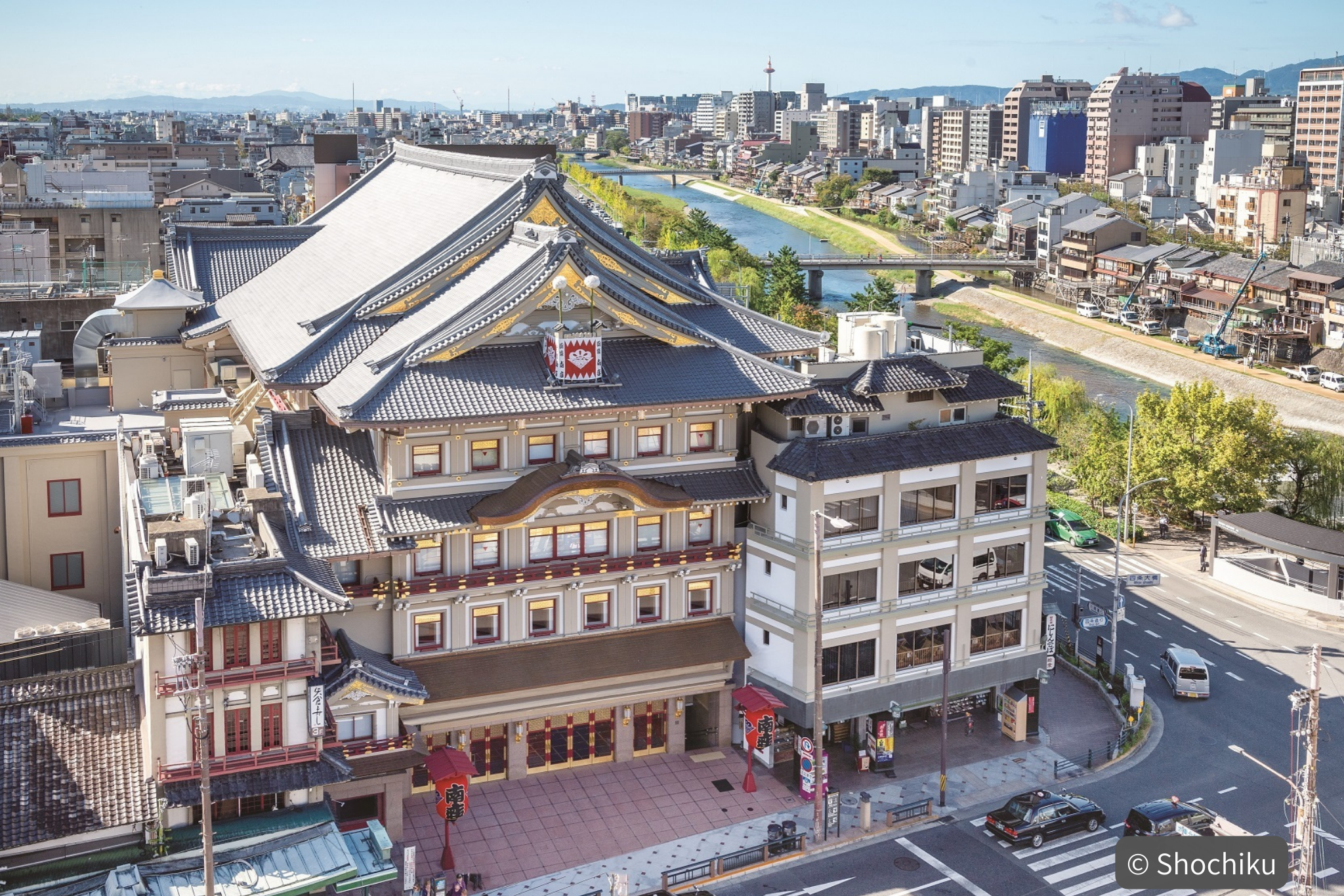
Kabuki (歌舞伎) is written with Chinese characters that comprise its artistry: song, dance, and acting. All roles are played by men in an art form that employs bold expression through fantastic exaggeration and stylized acting that go beyond realism. During the Edo period (1603-1868), the Edo (Tokyo) and Kamigata (Kyoto-Osaka) regions were the areas where Kabuki was most popular among the common people. Kabuki continues to be very popular today.
Kabuki History
The word “Kabuki” comes from the word “kabuku,” meaning “to lean” or “bizarre.” Kabuki dance, which is how Kabuki is said to have begun, was performed in imitation of the eccentric young men and ronin (masterless samurai) who were on the cutting edge of fashion, in costumes imitating their bold and bizarre youthful tastes. Kabuki originated with the female dancer Okuni, who dressed as a swaggering young man and caused a sensation when she came to Kyoto from the provinces in 1603.
While Noh plots feature the gods, nobility, samurai heroes, and their wives, Kabuki plots favor naïve politicians, sly villains, enamored playboys, star-crossed lovers, high-ranking prostitutes, con men, and thieves.
By the mid nineteenth century, many of the famous plays that are still performed today were produced, such as “Kanadehon Chushingura” (The Treasury of Loyal Retainers) and “Sukeroku.” Current production techniques were also established.
After the Meiji era (1868-1912), modern European theater was introduced to Japan, and later, new media such as movies and television entered the country. As these new forms and media became popular, Kabuki constantly evolved by incorporating elements from them. In 2008, Kabuki was designated an Intangible Cultural Heritage by UNESCO.
Aspects of Kabuki
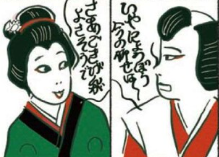
There are various conventions in Kabuki. By understanding them, you can deepen your understanding and enjoyment of the art.
Roles
Tachiyaku: The lead adult male role. The role of the hero is especially important, classified according to the content of the performance as “Jitsugoto” (an actor with great integrity.)
“Aragoto” (“rough-style”), a righteous warrior with superhuman strength,
“Wagoto” (“gentle-style,” also called “Nimaime”) excels at romantic scenes. Other roles include clowns (Sanbanme) and old men.
Onnagata: Female roles. It is said that male actors began to play female roles after women were prevented from appearing on the stage with the banning of “Onna kabuki” by female prostitutes in 1629.
Mie (Frozen pose)
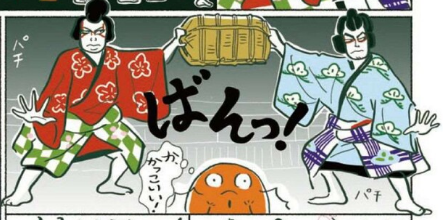
To express an important moment in a story or a heightened emotion, the actor stops acting and strikes a dramatic pose, as if in stop motion. This is the mie pose of Kabuki. The audience’s attention is instantly concentrated. The pose is accented by the tsuke beats, made by rhythmically striking two wooden sticks on the stage floor.
Costumes
A variety of costumes, including colorful kimono, are used to represent the age, status, and rank of each character. The style of the lower half of the body displays the characteristics of the role. Townsmen and ronin wear kimonogashi (traditional Japanese dress without hakama pleated trousers) while samurai wear hakama. Red represents righteous blood, and black represents authority. Most princesses wear long furisode sleeves with a patterned motif on a red robe.
Makeup
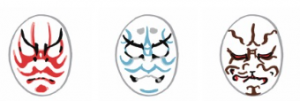
In Kabuki, the face is painted white, with eyebrows and eyes making a strong impact. Thick red or blue lines called kumadori are painted on.
In the Edo period when Kabuki flourished, there was no electricity, so actors painted their faces white to make themselves stand out in the dim theaters. Kumadori is a way to emphasize facial expressions so that the audience can see them clearly from a distance, even in dim light.
The roles portrayed determine the color and manner in which the lines are drawn. All makeup is applied by the actors themselves. The colors have symbolic meaning:
- Red: Heroes with courage, justice, and strength
- Indigo: Villains (especially the worst villains)
- Brown: Non-human supernatural roles such as monsters and ghosts
Stage
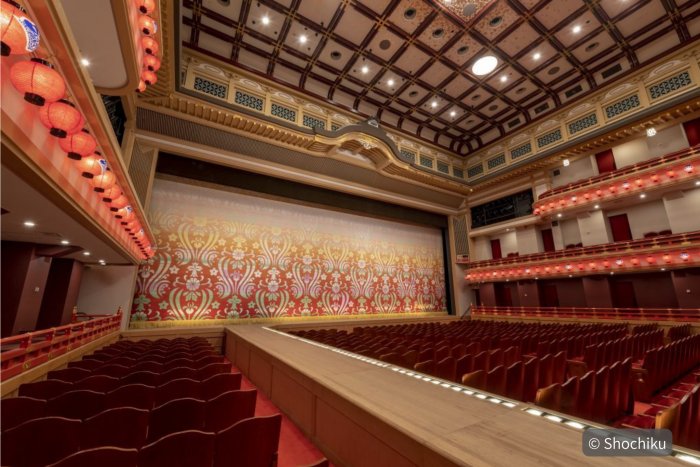
A standard stage curtain. In contrast, Kabuki performances use three-colored, striped curtains.
A distinctive feature of Kabuki is the spectacle: stunning stage effects, sets, and stage properties.
The mawari-butai is a central circular area that turns 360 degrees. The seri are portions of the stage floor that can be raised or lowered, allowing characters to suddenly appear or disappear. The gando-gaeshi have painted sets that can be tipped back 90 degrees to instantly change to a new scene.
Another stage structure unique to Kabuki that deserves special mention is the hanamichi, (literally “flower path”) which is a straight strip of stage stretching from the back of the audience to the main stage. It is used not only for the appearance and exit of characters, but also for staging certain scenes, to the delight of audiences on both sides.
Realistic properties are custom-made and handmade for each production, recreating historically accurate, if stylized, reproductions of commoner and samurai homes, temples, and brothels etc.
Curtain

Three colors of the Kabuki curtain
Kabuki curtains are dyed in three colors: black, green, and persimmon russet. The curtain is drawn sideways across the wide stage, rather than lowered, and is used only for the opening and closing of the play.
In the Edo period (1603-1868), only three theaters were permitted to employ this special curtain, and the colors were arranged differently. Since the Meiji era (1868-1912), the current three-color curtain has been in general use for all Kabuki theatres.
Music
All music and sound effects in Kabuki are performed live. In a small room to the left of the stage (from the spectators’ perspective) called the kuromisu (“black blind”), sound effects and background music are played during the performance.
Also, offstage are the nagauta singers and shamisen players, and the narimono (small drums, large drums, flutes, drums, etc.), although at times nagauta singers and shamisen players appear on stage.
→ For more information about nagauta and Japanese musical instruments, please refer to:
Jishibai
Kabuki performed by famous professional actors is called “Grand Kabuki.” (See list below). In contrast, Kabuki performed by local amateur actors and rooted in a local area is called jishibai, or folk Kabuki.
In the Edo period (1603-1868), Kabuki was a well-loved entertainment of the people. Ordinary citizens (farmers) learned from admired professionals and eventually could enjoy performing the plays themselves.
In Japan today, this type of jishibai still exists in many localities, performed by local people at remaining old theaters and for special events. It is characterized by the fact that, in addition to performing, local people take the lead in creating performances, from stage-building to promotion and reception staff.